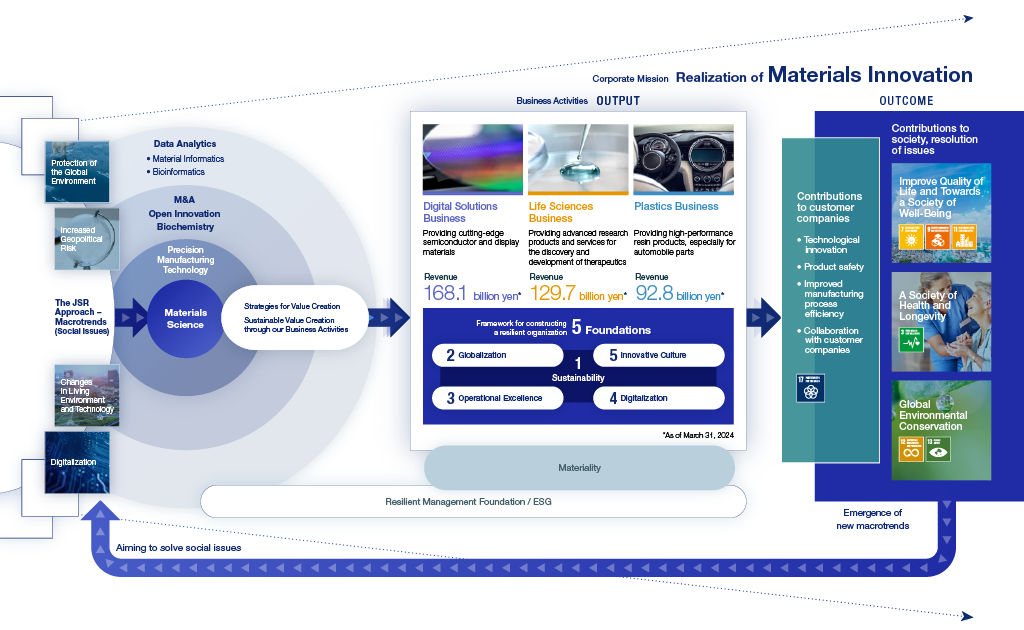
JSR Group’s Materiality ~FY2022-FY2024~
JSR Group’s Materiality
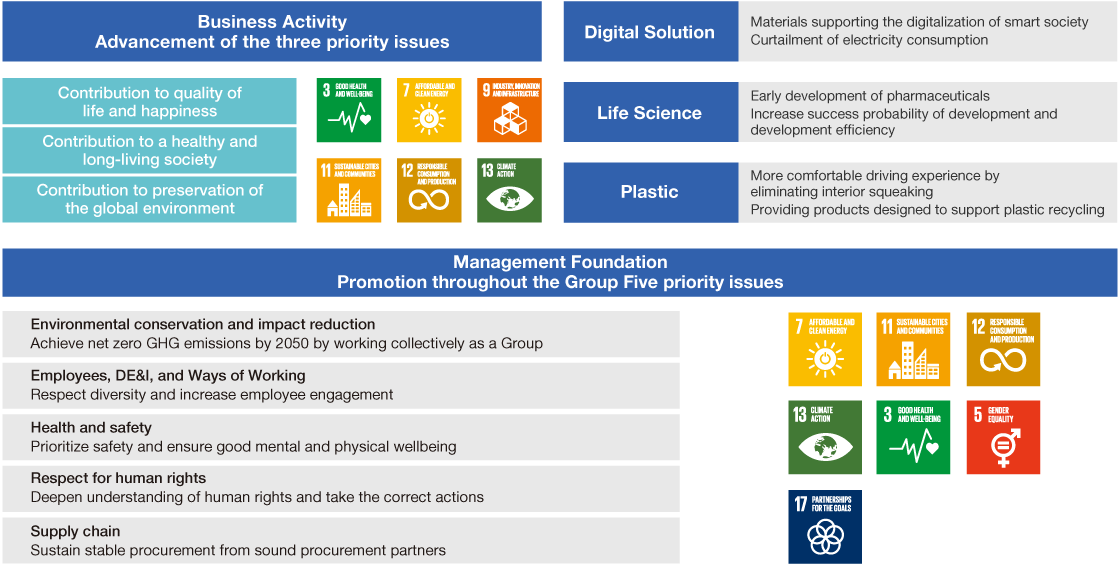
We have identified materiality (priority issues) aiming to help bring about a sustainable global environment and society by creating value through corporate activity, following our Corporate Mission of “Materials Innovation — We create value through materials to enrich society, people and the environment.” This materiality is reflected in the Medium-term Management Policy announced in March 2021 and positioned at the center of our resilient management foundation.
1. Materiality Identification Process
Based on the findings from dialogue held with experts in 2019, we began reviewing the existing materiality (formulated in 2015) from the same year.
From FY2019 to FY2020, as part of JSR Sustainability Challenge,* with the participation of our employees, we reorganized our materiality into two perspectives: business activity and management foundation. In implementing this process, we received opinions and summaries from Mr. Keisuke Takegahara of the Development Bank of Japan as an outside expert.
*JSR Sustainability Challenge: An initiative where discussions were conducted to grasp the positive and negative social impacts of the Group’s five business segments to determine the material impacts, both positive and negative, of JSR Group’s business activities.
- JSR Report 2020 – JSR Sustainability Challenge / Summary of Business Activities (PDF: 86KB)
- Sustainability Report 2021 – JSR Sustainability Challenge / Management Foundation Implementation Process and Summary (PDF: 435KB)
- Looking back at the process of developing the “new materiality” from the 2019 dialogue with Mr. Keisuke Takegahara
2. Future Reviews
We believe that our materiality will evolve amid continuing changes in what society demands of us as well as in our various stakeholders’ views and needs. Going forward, we will therefore continue to identify and review materiality through the following operations.
- 1.We will respond accordingly whenever the need to review the validity of materiality arises through engagement with experts and employees as well as Responsible Care activities, etc.
- 2.Whenever we formulate new medium-term management policies, we will ensure (and periodically review) the transparency and acceptability of the processes that we apply when specifying materiality by exchanging views with experts.
Establishment and Advancement / Results of KPIs for Materiality
1. Establishment of Key Performance Indicators (KPIs) for Materiality
In FY2021, we established Key Performance Indicators (KPIs) for our issues of materiality. During this process, the Sustainability Promotion Department, with the support of the Corporate Planning Department, discussed and shared sustainable management issues facing JSR Group together with business departments, corporate departments, and Group companies to determine specific KPIs and numerical targets.
2. Advancement / Results of Materiality KPIs
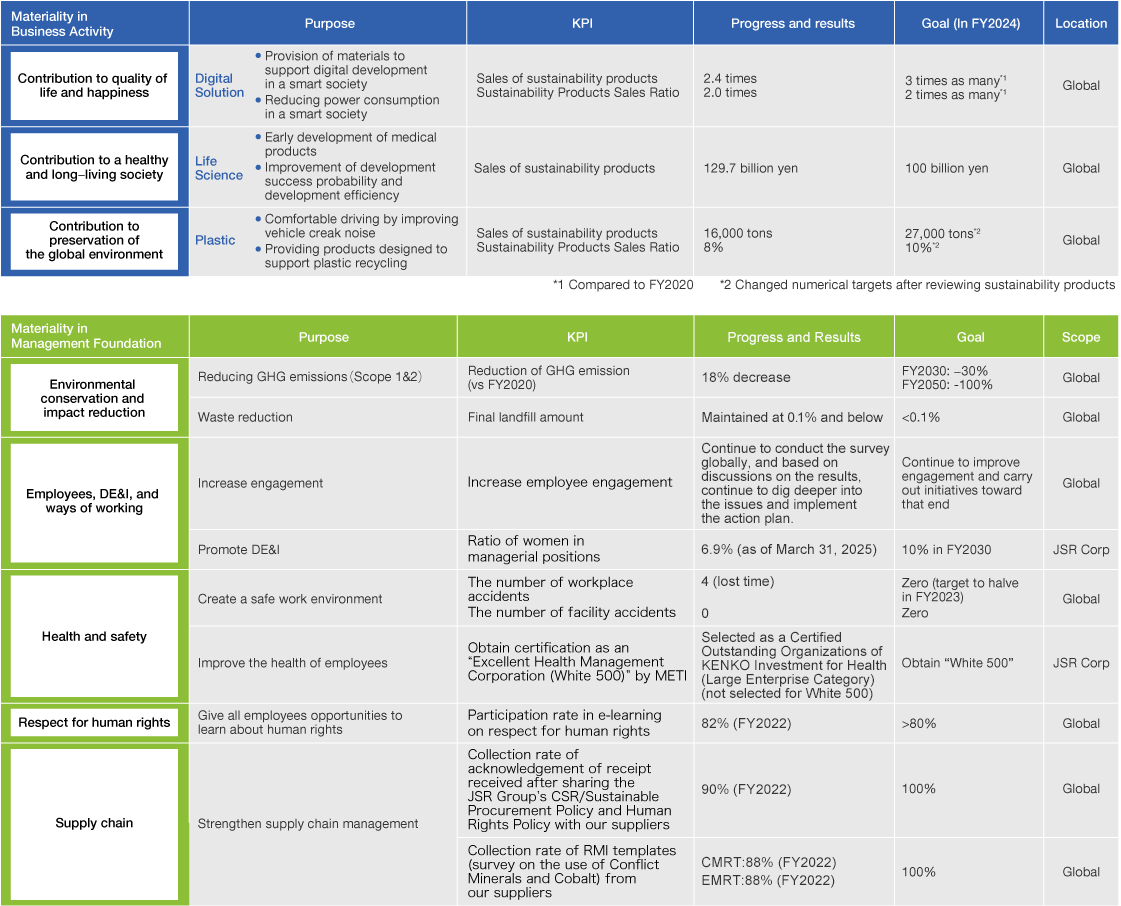
The applicable materiality covers the period from FY2022 to FY2024. In FY2024, the final year of this materiality, we confirmed the achievement status of each KPI and obtained results that will serve as the foundation for the next strategy.
The materiality of Business Activity stipulated that the Group contributes to society by providing products and services that demonstrate various effects in “Contribution to Quality of Life and Happiness,” “Contribution to a Healthy and Long-Living Society,” and “Contribution to Preservation of the Global Environment,” in each of the Digital Solutions Business, Life Sciences Business, and Plastics Business that the Group engages in.
Based on this, we have defined “sustainability products” in each business domain from among all the products provided by JSR Group, set KPIs such as sales, sales volume, and sales ratio, and established targets for FY2024.
In FY2024, we set a target of tripling sales of sustainability products in our Digital Solutions Business compared to FY2020, and in FY2024 we achieved a 3.5-fold increase. In addition, we aimed to double the sales ratio compared to FY2020 and achieved a 2.3-fold increase.
In addition, the “Management Foundation” that supports our business activities has five forms of materiality: “environmental conservation and impact reduction,” “employees, DE&I, and ways of working,” “health and safety,” “respect for human rights,” and “supply chain.” Therefore, we have set medium- to long-term issues and KPIs for each of these.
In particular, for “environmental conservation and impact reduction,” we have set a target for FY2030 of reducing greenhouse gas emissions by 30% from the FY2020 level by FY2030, and have achieved an 18% reduction as of FY2024. Furthermore, in order to achieve sustainable growth and fulfill our social responsibilities, we set a Science Based Target (SBT) of a 42% reduction by FY2030 compared to FY2023 and obtained SBTi certification in July 2025.
The background and characteristics of the materiality of “Management Foundation” are as follows. Detailed progress of materiality KPIs is described in the relevant sections of each.
Environmental Conservation and Impact Reduction
Climate change and resource depletion are issues threatening the very future of humankind. To resolve these worldwide social issues, JSR Group will begin by aiming to reach net zero GHG emissions by 2050 and eliminate waste bound for landfills entirely.
Employees, DE&I, and Ways of Working
We believe that advancing flexible and diverse ways of working, utilizing each other’s individual abilities and approaches, and working with higher engagement will improve organizational competitiveness and ultimately elevate corporate value.
In particular, we believe that the advancement of DE&I in managerial grades, which plays a central role in organizational management, will lead to improved resilience of JSR Group as a whole. Therefore, based on the social issues unique to Japan, we have set the ratio of female managers at JSR (nonconsolidated basis) as a KPI. We regard this as one of the metrics that reflects the results of ensuring “fairness of opportunities” for each employee’s challenges, active participation, and growth, and we will accelerate the creation of a DE&I culture using this KPI as a driver.
Safety and Health
For safety, we will use the number of accidents occurring after safety activities and results of the safety culture survey for measuring the progress of this process as KPIs and adopt uniform standards for evaluating safety performance globally.
For health, we targeted White 500 certification for JSR. During and after the pandemic, we have positioned the balance between employee health and productivity as an important management issue that we are now working diligently to address.
Respect for Human Rights
Companies are responsible for setting an example when it comes to respect for human rights. To fulfill this responsibility, each and every JSR Group employee must deepen their understanding of human rights. Based on this approach, through e-learning and other means, we will focus on initiatives that educate our people about human rights continuously and systematically.
Supply Chain
To share societal needs and JSR Group’s philosophy with suppliers and to prevent risks before they materialize, we distribute booklets containing JSR Group’s CSR/sustainable procurement and human rights policies to foster supplier understanding and we ask that they submit a written endorsement. With regard to conflict minerals and cobalt, which pose concerns in terms of child labor and other human rights abuses, we will use commonly used questionnaires worldwide to monitor JSR Group’s use of these commodities and suppliers’ responses to preventing human rights abuses.
- Related Links
- Providing Value to Society through Our Business Activities: Contribution to Preservation of the Global Environment | Sustainability | JSR Corporation
- Providing Value to Society through Our Business Activities: Contribution to Quality of Life and Happiness | Sustainability | JSR Corporation
- Providing Value to Society through Our Business Activities: Contribution to a Healthy and Long-Living Society | Sustainability | JSR Corporation
In light of the evaluation based on these results, changes in social needs, and the various expectations of our stakeholders, we will review our materiality and reflect the findings in our medium-term management plan for FY2025 and beyond.
Value Creation Story
We seize upon social issues and use JSR’s technological strengths to strive to contribute to society and increase our corporate value.