

Risk Management
Governance and Management Framework
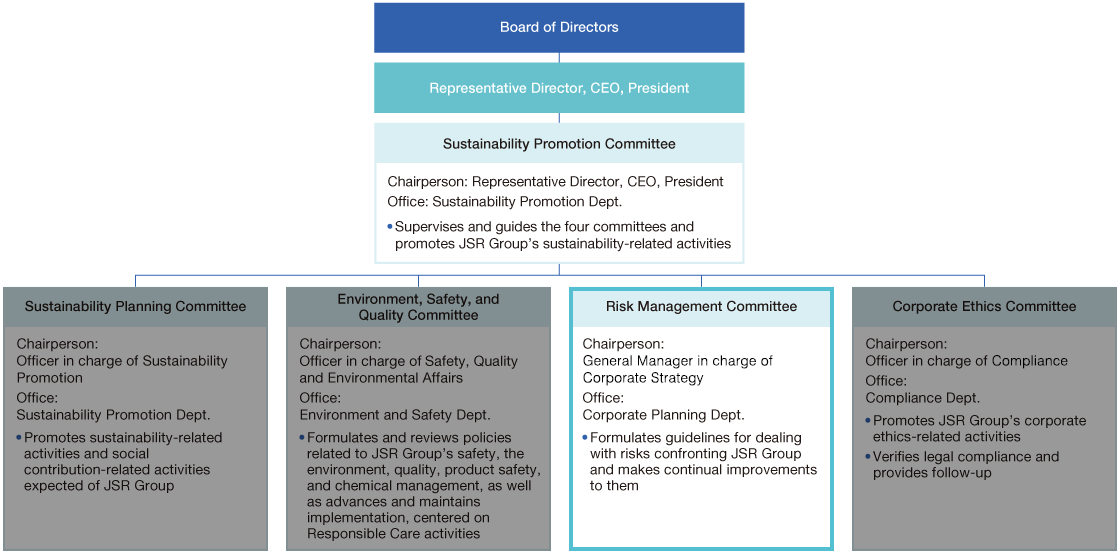
JSR Group has established a Risk Management Committee under the Sustainability Promotion Committee. We have put into place a structure whereby the Risk Management Committee comprehensively manages important risks that have materialized or could potentially materialize within the Group.
The Risk Management Committee advances the Group’s risk management by taking the lead in identifying important risks and supporting the formulation of policies for responding to such risks and the planning and execution of risk management plans by related committees or departments in charge. For important risks that were identified, the progress of countermeasures is reported to the Sustainability Promotion Committee and the Board of Directors.
The risk management system forms part of the Group’s internal control system. The status of the internal control system’s execution is reported regularly to the Board of Directors. JSR’s Corporate Audit Department continuously verifies and evaluates the preservation and operation of internal control for the entire JSR Group as required by the Companies Act and Financial Instruments and Exchange Act. It also ensures that risk in existing business does not exceed permissible levels. Furthermore, the department additionally strives to maintain and strengthen internal control levels for the entire Group and conducts internal audits to ensure the appropriate and efficient execution of operations.
Policy and Basic Approach
JSR Group believes that preventing major crises from occurring and minimizing their impacts on business activities are priority issues for management. In response to these issues, the Group has formulated the JSR Group Risk Management Policies to address risk management.
The JSR Group Risk Management Policies were established in November 2023 after reviewing the current regulations, such as the Risk Management Policies, which define the identification of risk as well as the selection and management of material risks, and the BCM Procedure, which summarizes the BCM/BCP* structure in normal times and emergencies.
Based on these policies, we will advance risk management activities globally by visualizing risks throughout the Group, even for new and increasingly complex risks.
- *BCM: Business Continuity Management; BCP: Business Continuity Plan
A BCP defines activities to be conducted in anticipation of emergencies that could threaten a company’s survival (such as a large-scale natural disaster, explosion/fire, or terrorist attack), judgment criteria and courses of action that enable business continuity in the event of such emergencies, and other matters necessary for ensuring the continuity and early restoration of important businesses. BCM is a management system that operates and continuously improves the BCP through the PDCA (plan-do-check-act) cycle.
Initiatives
1. Identifying Risks and Selecting Important Risks
Under the initiative of the Risk Management Committee, each division of JSR Group companies in and outside of Japan identifies risks on a regular basis. We strive to comprehensively manage risks, including potential serious risks, by combining the identification of risks related to management strategies and the foundation of business continuity by management along with the identification of operational risks from all divisions using a bottom-up approach.
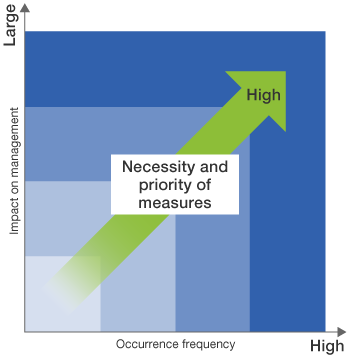
The identified risks are classified in terms of the degree of impact on management and the frequency of occurrence through the use of the risk map. Key risks that could potentially have a significant impact on business continuity are listed and managed as JSR Group Business and Other Risks. In addition, we have designated a department in charge to lead the planning and implementation of countermeasures for each material risk, while the Risk Management Committee checks the progress of these measures as appropriate to manage risks.
Click on the following link for information on JSR Group Business and Other Risks.
2. BCM (Business Continuity Management)
The JSR Group Risk Management Policies stipulate the umbrella organization and operational structure of BCM/BCP in normal times and emergencies, as well as the criteria for activating and terminating the BCP. In addition, we have formulated a manual for each business for the resumption of business activities after a crisis has been resolved.
3. Enhancement of Initial Response to Emergencies
(1) Conducting Crisis Management Training
In FY2024, we conducted BCP training for JSR Group companies in Japan with the objective of enhancing the response capabilities of the headquarters for accident and crisis control at each Group company in the event of a crisis. Twenty people from five Group companies in Japan participated in the training.
The training was conducted in the format of a simulation assuming the occurrence of a large-scale earthquake. Participants confirmed the actions they should take, such as gathering information and determining response policies, in response to situations that could occur in the event of a disaster. Through this training, the participants reconfirmed the importance of establishing judgment criteria in advance in order to respond appropriately in an emergency, as well as the importance of continually improving the emergency response manual.
We will continue to cooperate with Group companies to reduce damage and improve the business continuity capabilities of JSR Group by conducting training for various crisis scenarios.
(2) Disaster Management Training at Each Plant and Laboratory
JSR Group conducts systematic training on a regular basis for disaster management, fire suppression, evacuation, and notification. Group companies in Japan conduct training in accordance with the Fire Service Act, the Act on the Prevention of Disaster in Petroleum Industrial Complexes and Other Petroleum Facilities, and other laws and regulations. Group companies in other countries conduct training as required by the laws and regulations of each country or region and the actual situation.
(3) Enhancement of Safety Confirmation System
In FY2009, JSR Corporation introduced a safety confirmation system that uses employees’ mobile phones and smartphones. The system can promptly ascertain the safety of employees in the event of a large-scale earthquake or other disasters. In FY2011, we began expanding the scope of coverage to include Group companies in Japan and the families of JSR employees.
This system was used to confirm the safety of employees during the Noto Peninsula earthquake in Ishikawa Prefecture and the Hyuga-nada offshore earthquake in Miyazaki Prefecture in 2024.