

Addressing Climate Change
Governance and Management Framework
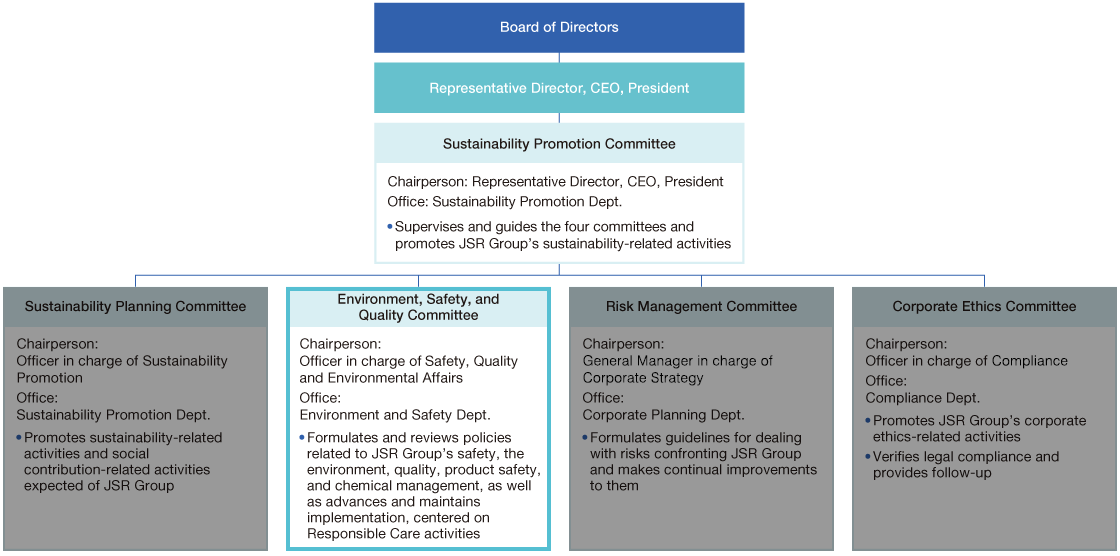
JSR Group utilizes a supervisory structure, overseen by the Board of Directors, to examine and carry out appropriate responses to issues that could potentially pose business risks or represent business opportunities.
Furthermore, JSR Group has established the Sustainability Promotion Committee, chaired by the CEO and President, as a cross-functional meeting body to advance the implementation of sustainability activities.
In particular, with regard to climate change response, the Sustainability Planning Committee, which is responsible for planning overall strategies on sustainability, sets the direction of company-wide activities, while the Environment, Safety and Quality Committee is responsible for approving the action plan related to climate change of the entire organization and evaluating and verifying the results of activities. The Risk Management Committee is responsible for managing the implementation of and improving response policies and response plans with regard to apparent and latent risks and opportunities identified through assessments. The Sustainability Promotion Committee supervises and guides the activities of these three committees and strives to strengthen management and advance activities through regular meetings held four times a year and extraordinary meetings.
Policy and Basic Approach
As a company that manufactures chemical products, JSR Group considers response to climate change issues faced by the society as one of its top priority issues, and that it is the Group’s responsibility to contribute to the realization of a decarbonized society.
Our chemical products are ultimately used in various products. Therefore, we believe it is necessary to work to reduce greenhouse gas (GHG) emissions throughout the lifecycle of our products.
We will contribute to the reduction of GHG emissions in society as a whole by promoting the calculation and understanding of GHG emissions throughout the Group and working to reduce energy consumption in the various processes of producing and providing products.
Metrics and Targets
JSR Group continuously reviews and enhances its reduction targets to achieve "Net Zero" GHG emissions by 2050.
Toward the realization of "Net Zero" by 2050, we set the reduction targets for FY2030 in 2021. In FY2025, considering external situations, we set the new targets aligned with the 1.5°C goal and are working to further reduce GHG emissions.
1. GHG Emissions Reduction Targets Toward Net Zero GHG Emissions in 2050
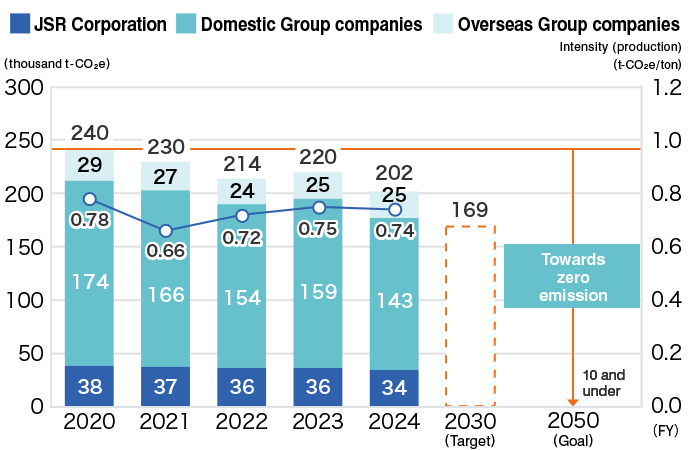
JSR Group announced in March 2021 that it aims to achieve net zero GHG emissions in 2050. In December 2021, we set a milestone for achieving this target: reducing GHG emissions by 30% for the entire JSR Group by FY2030 (base year: compared to FY2020).
| Target 1 | Reduce greenhouse gas emissions (Scope 1 + Scope 2) by 30% by FY2030 (compared to FY2020) |
|---|
| Base Year | Result | ||||||
|---|---|---|---|---|---|---|---|
| Metrics | Boundary | Unit | FY2020*1 | FY2021*1 | FY2022 | FY2023 | FY2024 |
| Scope 1 | JSR Group | 1,000 tons-CO2e | 35 | 35 | 34 | 34 | 34 |
| Scope 2 | 205 | 195 | 180 | 186 | 169 | ||
| Scope 1 + Scope 2 total | 240 | 230 | 214 | 220 | 202 | ||
| Progress (base year: compared to FY2020) |
% | ― | -4 | -11 | -8 | -16 | |
- *1Numerical values exclude the Elastomers Business, which was business transferred in April 2022.
- *2Scope 3 emissions are shown in the ESG Data Book.
In FY2024, our GHG emissions decreased by 8% from the previous year to 202,000 t-CO2e, and by 16% from FY2020, the base year, as a result of continued implementation of energy conservation advancement activities and switching to renewable energy for purchased electricity.
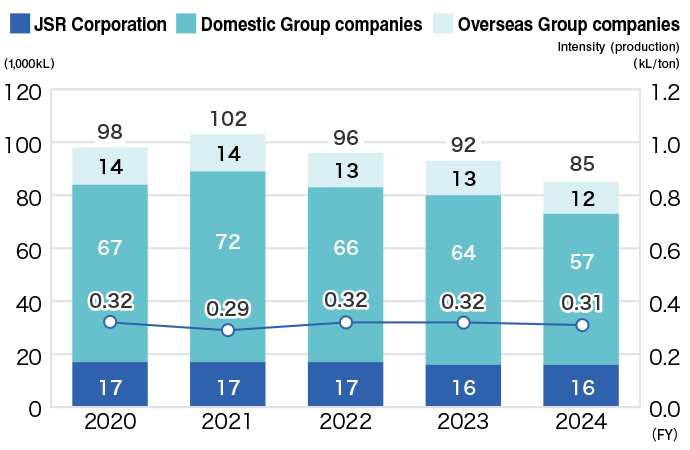
our energy consumption in FY2024 was 85,000 kL, 8% decrease from the previous fiscal year.
2. GHG Emissions Reduction Targets Consistent With the 1.5°C Target
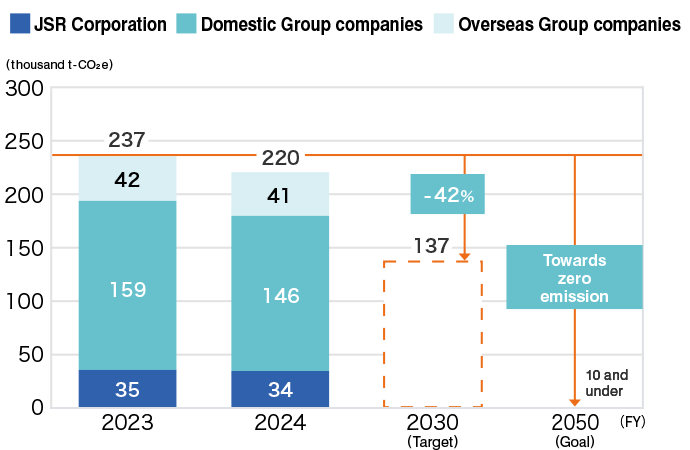
In FY2025, JSR Group reviewed its GHG emissions reduction targets to align them with the 1.5°C target of the Paris Agreement, and obtained certification under the Science Based Targets initiative (SBTi).
| Category | Target2 | |
|---|---|---|
| Scope1 | Direct GHG emissions from the company | JSR Corporation commits to reduce absolute Scope1 and 2 GHG emissions 42% by 2030 from a FY2023 base year. |
| Scope2 | Indirect emissions resulting from the use of electric power, heat, and steam supplied by other companies | |
| Scope3 | Indirect emissions other than Scope1 and Scope2(emissions from other companies relating to business operators' activities) | JSR Corporation also commits that 85% of its suppliers by emissions covering purchased goods and services, capital goods and upstream transportation and distribution, will have science-based targets by FY2029. |
We will continue to advance the reduction of the environmental impact of our business activities by setting these goals as the new GHG emissions reduction target for JSR Group.
Scope 1 and Scope 2 GHG emissions in FY2024 were 220,000 t-CO2e, 7% decrease from the base year of FY2023.
| Base Year | Result | |||
|---|---|---|---|---|
| Metrics | Boundary *3 | Unit | FY2023 | FY2024 |
| Scope 1 | JSR Group | 1,000 tons-CO2e | 37 | 37 |
| Scope 2 | 200 | 183 | ||
| Scope 1 + Scope 2 total | 237 | 220 | ||
| Progress (base year: compared to FY2023) | % | ― | -7 | |
- *3In accordance with the acquisition of SBTi certification, the boundary for FY2023 and FY2024 has been changed from the calculation of Target 1, and Group companies over which JSR Corporation has financial control are included in the scope of calculation.
- *4Scope 3 emissions are shown in the ESG Data Book.
Initiatives
1. Response to the TCFD Recommendations
JSR Group expressed its support for the TCFD recommendations in October 2020 and conducts information disclosure based on the TCFD framework.
For more information, please refer to the TCFD Report.

2. Third-Party Verification of GHG Emissions
To ensure transparency and accuracy of certain the GHG emissions data (Scope 1 and 2) disclosed by JSR Group, we obtain third-party verification.
3. Introduction of Renewable Electricity
To achieve the previous target of reducing GHG emissions by 30% for the entire JSR Group by FY2030 (compared to FY2020) and the new target of reducing GHG Scope 1 and 2 emissions for the entire JSR Group by 42% by FY2030 (compared to FY2023), we are introducing renewable electricity at all or part of the following sites / companies.
Through these initiatives, the share of renewable electricity in JSR Group’s total electricity use reached 14.5% in FY2024.
| JSR Corporation | Domestic Group Companies | Overseas Group Companies |
|---|---|---|
|
|
|
4.JSR BiRD Adoption of Geothermal Heat Utilization System
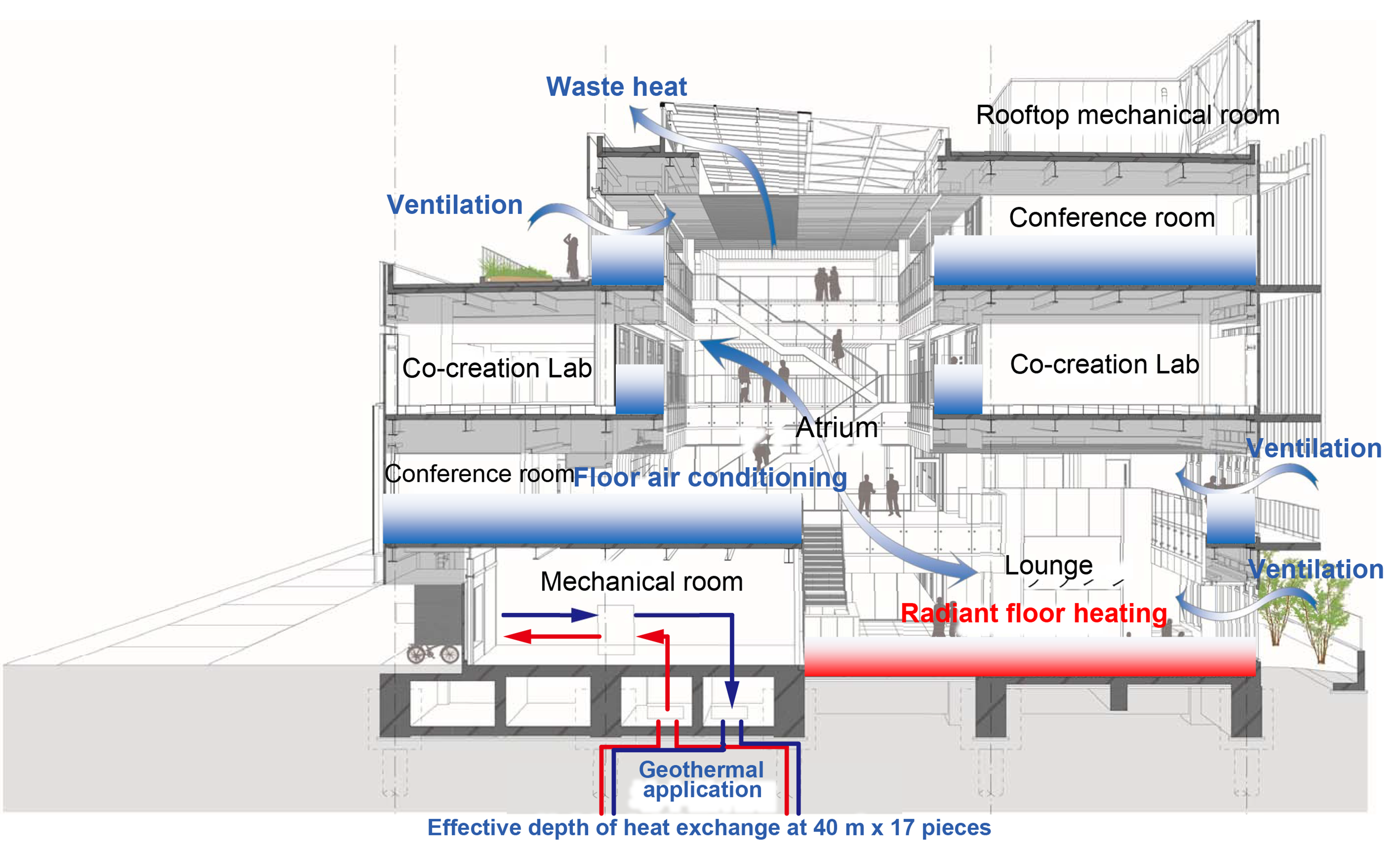
JSR BiRD*5, which started operation in 2021, has adopted a cooling and heating system which uses geothermal heat (geothermal heat utilization system).
The temperature in the ground is lower than the outside temperature in the summer and higher than in the winter. We have built an effective cooling and heating system using this temperature difference. This system has reduced CO2 emissions resulting from the generation of cold and hot water further than with conventional air conditioning systems. That has led to a reduction in the environmental impact.
<Facility features>
- (1)Incorporating natural ventilation that blends with the atrium shape
- (2)Floor-ducted air conditioning and radiant floor heating to the atrium and work areas
- (3)Geothermal heat pump system that takes advantage of the 50 m pile length
- *5This stands for JSR Bioscience and informatics R&D center. It is a JSR research facility we newly established in 2021 for the creation of new business.
5. GHG Emissions Reduction by Optimizing Cleanroom Operating Conditions at the Yokkaichi Plant of JSR Corporation
At the Yokkaichi Plant of JSR Corporation, energy conservation efforts are focused on cleanroom air conditioning, which accounts for the majority of energy consumed in the plant.
Specifically, the load on the cleanroom is controlled by optimizing the temperature, humidity, and other operating conditions of the outside air treatment air conditioner and adjusting the balance between supply and exhaust air.
In addition, in FY2023, the inverter control was introduced for circulating pumps. By switching to a system that supplies only the necessary flow rate, we have reduced inefficientoperation and power consumption.
Through these initiatives, we achieved a reduction of approximately 10% in GHG emissions in FY2024 compared to the FY2022 level before the initiatives were implemented.
We will continue to work on sustainable business operations by further reducing our environmental impact and improving energy efficiency.
6. Collaboration With Specialized Networks on Climate Change
We participate in organizations including the Japan Chemical Industry Association, the Semiconductor Climate Consortium (SCC), and the Japan Climate Leaders’ Partnership (JCLP) to collect information and improve our awareness that climate change will bring about both risks and opportunities for JSR Group. Accordingly, we formulate and implement strategies based on scenario analysis.